
A wire rope is not a solid steel rod; instead, it is formed by twisting steel wires into strands, which are then twisted together to form the rope. The direction of this spiral is known as the "lay direction."
Determining the lay direction is simple: hold the strand or rope vertically and observe the direction in which the outer wires or strands spiral upwards.
Z – Right-hand lay – Slants from bottom-left to top-right, resembling the diagonal stroke of the letter "Z".
S – Left-hand lay – Slants from bottom-right to top-left, resembling the diagonal stroke of the letter "S".
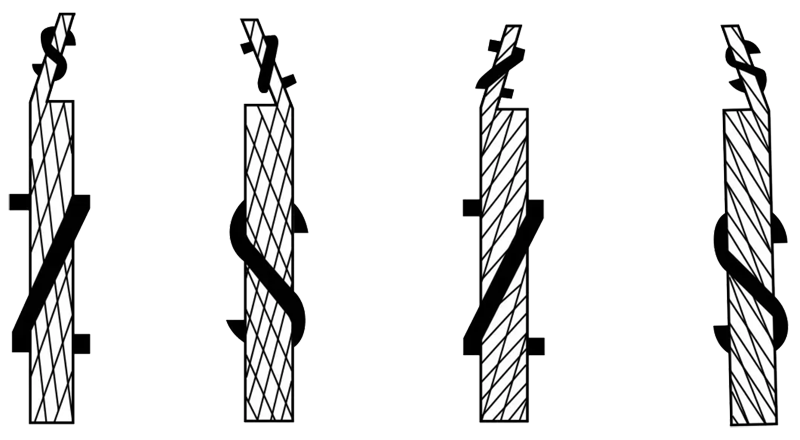
Common wire rope lay designations consist of two letters. For example, in "sZ," the lowercase "s" indicates the spiral direction of the wires within the strand, while the uppercase "Z" indicates the direction of the strands within the rope; together, they define the rope's complete lay configuration. Common types include:
sZ = RHRL = Right-hand regular lay
zZ = RHLL = Right-hand Lang's lay
zS = LHRL = Left-hand regular lay
sS = LHLL = Left-hand Lang's lay
In regular lay (or ordinary lay) ropes, the lay direction of the strands is opposite to that of the rope itself. Under load, they generate mutually counteracting torsional moments, making them resistant to unlaying and rotation, and structurally stable. Their disadvantages include a relatively small contact area with sheaves and drums, slightly higher bending stress, and generally lower wear resistance and flexibility compared to Lang's lay ropes.
In Lang's lay ropes, the lay direction of the strands is the same as that of the rope. The rope surface is smoother, the contact area with sheaves and drums is larger, and the wires slide more smoothly against each other during bending; these ropes are flexible, wear-resistant, and have good fatigue resistance. Their disadvantage is a strong tendency to rotate. If the free end is not securely restrained, they are prone to twisting, unlaying, and even "bird-caging" deformation.
Rotation-resistant wire ropes
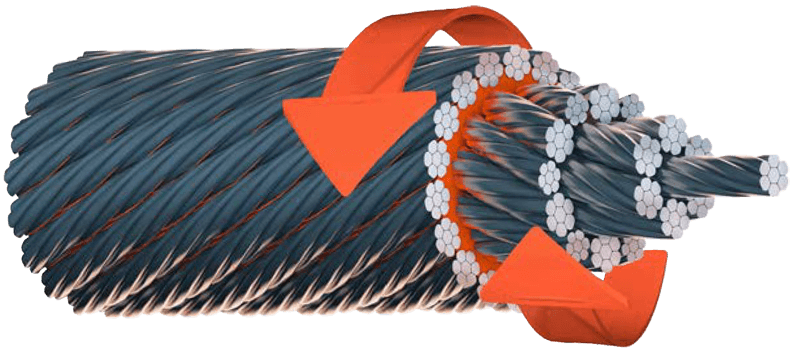
Rotation-resistant wire ropes typically feature a multi-layer strand construction, such as 18×7 or 35W×7. The inner and outer strands are laid in opposite directions; under load, the torques generated by the inner and outer layers cancel each other out, thereby minimizing rope rotation. Such wire ropes are commonly used for:
Tower cranes, crawler cranes, and truck cranes;
Dockside cranes;
Mine hoisting systems;
Lifting operations where there is a high risk of the hook spinning freely.
It should be noted that rotation-resistant wire ropes have stricter requirements regarding installation, anchoring, and loading conditions. If the inner strands are subjected to excessive load, separation between the inner and outer layers may occur, compromising both service life and safety.
The choice of wire rope lay direction also depends on how the rope is wound onto the drum. The general principle is that the winding direction should keep the wire rope tightly wound rather than causing it to "unwind" or twist in the opposite direction. Common matching configurations can be summarized as follows:
Drums with right-hand grooves are typically paired with left-lay wire ropes;
Drums with left-hand grooves are typically paired with right-lay wire ropes;
However, if the equipment drawings or manuals specify otherwise, those requirements take precedence. Mismatches between the lay direction and the drum can lead to poor spooling, inter-layer crushing, tangled ropes, and accelerated wear.