
If you examine a wire rope closely, you will see that it is not merely a jumble of wires twisted together at random; rather, it consists of a core and several wire strands. The strand is the most critical unit within the wire rope. Multiple wires are combined—based on specific geometric arrangements, diameter combinations, and twisting sequences—to form a strand; these strands are then twisted around a core to create the complete wire rope.
A typical wire strand generally comprises three components:
Strand core: Located at the center of the strand, this can be a single wire or a core made up of several wires;
Inner-layer wires: Arranged around the strand core, providing structural support and facilitating load transmission;
Outer-layer wires: Positioned on the outermost layer, these directly withstand friction and compression from contact with components such as sheaves, drums, and guide wheels.
Wire strands may consist of a single layer of wires or multiple layers. As the number of layers increases, the wire arrangement becomes more complex, and properties such as flexibility, load-bearing capacity, and wear resistance change accordingly.
One of the most important ways to classify wire strands is based on the contact characteristics between adjacent layers of wires within the strand.
1. Point-contact strands
Point-contact strands are typically formed by twisting layers of wires that all have the same diameter. Because the lay lengths (the distance of one full twist) differ between the inner and outer layers, the wires in adjacent layers do not lie parallel to one another; instead, they cross, resulting in contact points that are "point-like" in nature. Their characteristics include:
Relatively simple manufacturing process;
Greater strand flexibility;
Higher contact stress between wires;
Tendency for wires to slide relative to one another under load;
Wear resistance and fatigue life that are generally inferior to those of line-contact or surface-contact strands. Point-contact structures are commonly found in general-purpose or older wire rope designs; however, in critical applications, they have largely been superseded by line-contact and surface-contact structures.
2. Line-contact strands
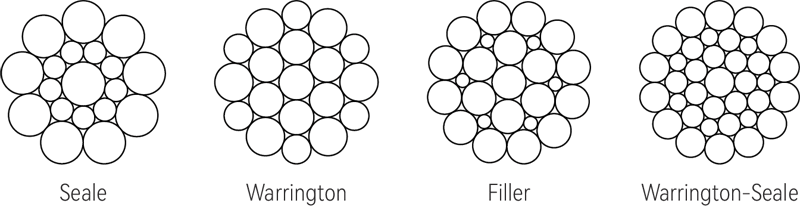
Line-contact strands represent a widely used structural type. Their characteristics include: wires of varying diameters are combined within the strand so that wires in adjacent layers lie parallel to each other along the helical path, creating "line contact." Common forms of line-contact strands include:
Seale (S) type: The number of wires in the inner and outer layers is usually equal; the outer wires are thicker, offering good wear resistance and strong crush resistance.
Warrington (W) type: The outer layer features alternating thick and thin wires, providing good flexibility and resistance to bending fatigue.
Filler (F) type: Fine wires fill the gaps between the inner and outer layers, resulting in a more compact structure and good crush resistance.
Warrington-Seale (WS) type: Combines the characteristics of both W and S types, balancing flexibility with wear resistance.
3. Surface-contact strands
Surface-contact strands are typically produced by subjecting line-contact strands to compaction processes—such as die drawing, roller pressing, or swaging—to create larger contact areas between wires, approaching actual surface-to-surface contact. Their characteristics include:
A more compact strand structure;
A smoother surface;
Lower contact stress;
Superior wear and crush resistance;
However, flexibility is somewhat reduced. Compacted strands are frequently used in applications requiring high load-bearing capacity, wear resistance, and structural stability.
Cross-sectional shapes of wire strands
Wire strands are not always circular. Common cross-sectional shapes include:
Round strands: The most common type; manufacturing technology is mature, and they have a wide range of applications.
Triangular strands: Offer a large load-bearing area and excellent crush resistance; commonly used in heavy-duty operations such as mine hoisting.