
Although the rope core does not directly bear the full tensile load, it functions much like a human spine, providing support, cushioning, lubricant storage, and structural stability.
Located at the center of the wire rope, the core performs several key functions:
Supporting outer strands: Prevents the rope from collapsing or deforming under compression.
Maintaining roundness: Ensures even distribution of strands and reduces internal friction.
Providing elastic cushioning: Absorbs some of the impact during bending, lifting, and hauling operations.
Storing lubricant: Grease within the core slowly seeps out, reducing wear between individual wires.
Enhancing crush resistance: Improves overall stability, particularly under conditions involving drums, sheaves, and heavy loads.
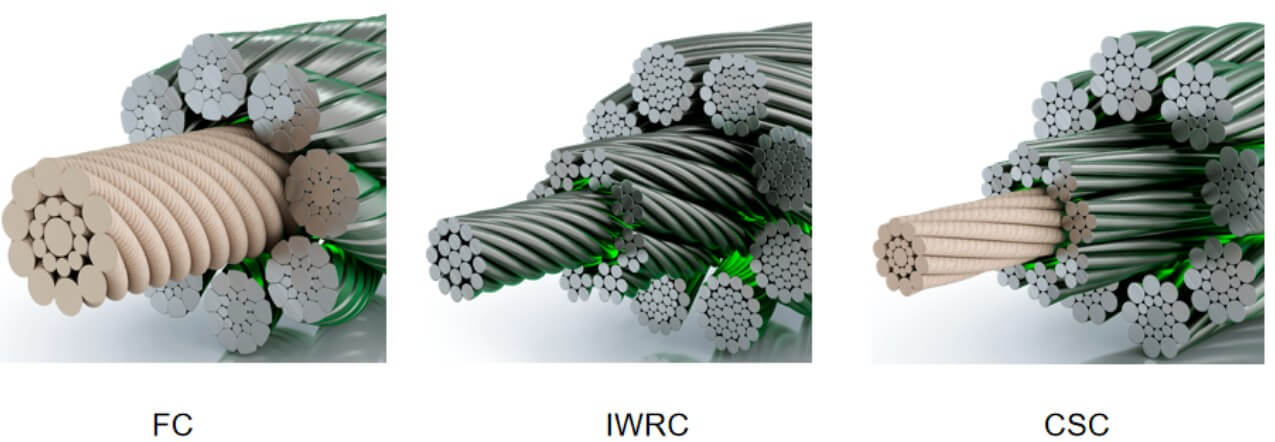
Fiber Core
Fiber cores are typically made from natural or synthetic fibers and are commonly designated as FC. They are characterized by good elasticity, high flexibility, and strong lubricant storage capabilities, making them suitable for applications requiring frequent bending. Wire ropes with fiber cores are generally more pliable, making them ideal for cranes, winches, and traction equipment where bending performance is critical. However, they offer relatively lower resistance to crushing and heat, making them unsuitable for environments involving prolonged exposure to extreme lateral pressure or high temperatures.
Steel Core
Steel cores can be further categorized into steel strand cores and independent wire rope cores (IWRC). They are characterized by strong support, excellent crush resistance, superior heat resistance compared to fiber cores, and greater structural stability (resistance to deformation). Steel-core wire ropes are better suited for heavy-load, high-temperature, multi-layer winding, or high-lateral-pressure applications, such as mine hoisting, port operations, and heavy lifting. However, compared to fiber cores, steel-core ropes are generally stiffer and offer slightly inferior bending performance.
Composite Steel Core
Commonly found in elevator wire ropes, these feature an outer layer of steel strands for support, while the inner fiber component serves to store lubricant and provide cushioning. Compared to an all-fiber core, a semi-steel core offers superior support and is less prone to flattening under load; compared to an all-steel core, it is generally more flexible and retains lubricant better.
When issues arise with the rope core, the wire rope may exhibit the following signs:
A noticeable reduction in diameter;
Localized flattening of the rope body;
Loosening or bulging of the outer strands;
Reduced ability to recover shape after bending;
Internal corrosion or an abnormal loss of lubricant;
Abnormal deformation under load.
These conditions can compromise the safety performance of the wire rope; therefore, timely inspections and replacements in accordance with standards are essential.