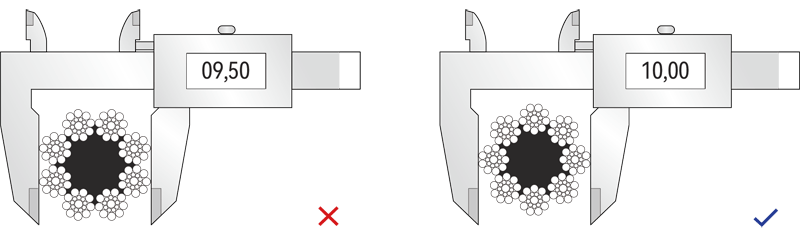
The nominal diameter of a wire rope can be understood as the "designated diameter" listed in specifications, on labels, or in contracts. It generally refers to the theoretical diameter of the circumscribed circle of the rope's cross-section.
It is important to distinguish between two concepts here:
Nominal diameter is a theoretical value used for tasks such as selecting the rope, placing orders, and matching it with pulleys.
Measured diameter is the actual diameter determined on-site, used for acceptance inspections, wear assessments, and determining when to retire the rope.
Why is the measured diameter of a wire rope often larger than the nominal diameter?
Wire ropes are constructed by twisting multiple strands of wire together; their surfaces are not perfectly smooth cylinders but feature ridges and grooves formed by the strands. Consequently, the actual outer diameter of a new rope is usually slightly larger than its nominal diameter.
For example, under ISO 2408 standards, the permissible diameter deviation for round-strand wire ropes ranging from 8mm to 60mm is generally 0% to +5%. This means the measured diameter of a new rope may exceed the nominal diameter slightly but cannot be smaller than it. Tolerances vary depending on the standard and application; for instance, wire ropes used in elevators or the oil and gas industry are subject to more specific classification requirements.
How can the wire rope diameter be measured accurately?
Select two cross-sections spaced at least 1 meter apart. At each section, take measurements in two mutually perpendicular directions, yielding a total of four values. The average of these four values represents the measured diameter of that section of the wire rope.