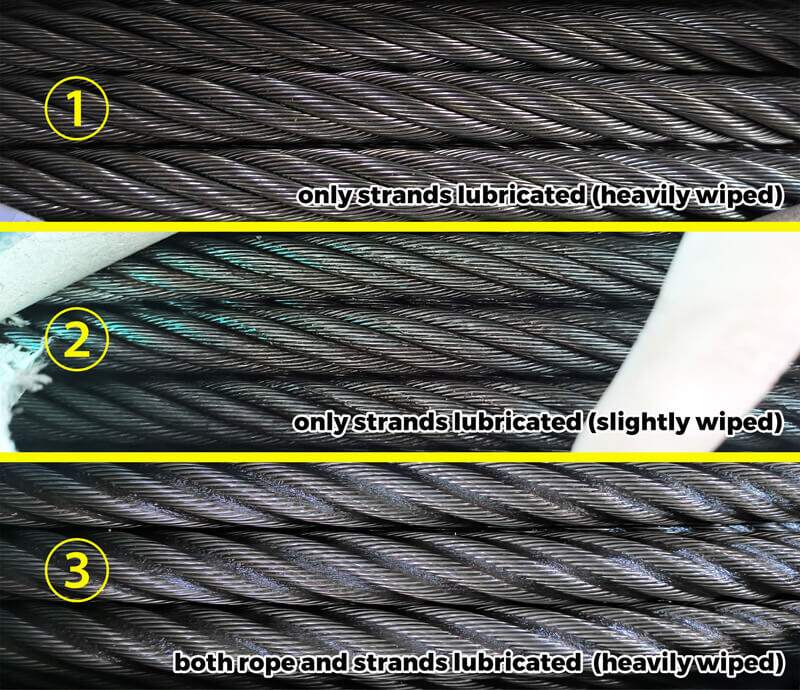
Pre-factory lubrication is critical, as it determines whether the wire rope contains sufficient initial lubricant.
1. Rope Core Impregnation
Cores such as fiber or synthetic cores usually require prior oil impregnation to transform them into "oil reservoirs." Common methods include:
Atmospheric impregnation: Soaking the core in an oil bath; this is simple but does not guarantee complete internal saturation.
Vacuum-pressure impregnation: Impregnating under vacuum or pressure; this yields higher and more uniform oil content but involves a more complex process.
A core with high oil content can slowly replenish lubricant to the internal wires during use, reducing internal friction and preventing the fiber core from molding or deteriorating.
2. Strand Surface Lubrication
During the strand-twisting process, lubricant is applied to each wire within the strand, allowing it to penetrate the gaps between the wires. Common methods include:
Spraying: Spraying or pressure-injecting heated, molten lubricant at the twisting point;
Pouring/Dripping: Pouring oil where the strands converge, allowing it to be carried into the interior along with the strands.
3. Rope Surface Lubrication
After the rope is closed (assembled), the entire wire rope undergoes surface lubrication. Common methods include:
Spraying method: Pressurized spraying of heated lubricant; this provides uniform coverage and high quality;
Dip coating method: Passing the wire rope through a hot oil bath; this coats the surface but offers limited internal penetration;
Pouring method: Pouring oil onto the moving wire rope; this is simple but prone to missed spots;
Lubricant application levels range from light to medium to heavy, selected based on operating conditions.
Generally, strand surface lubrication is chosen for indoor applications, while a combination of strand surface lubrication and rope surface lubrication is used for outdoor applications.