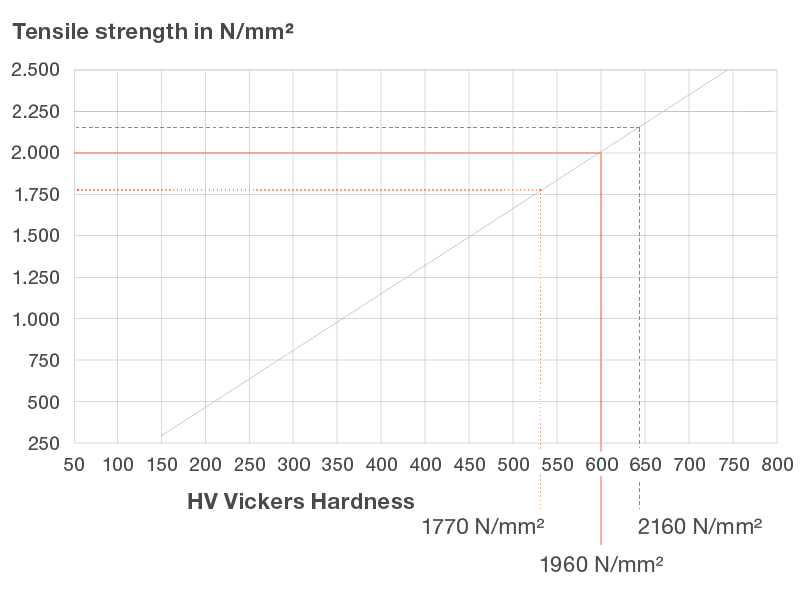
The tensile strength of wire is defined as the maximum longitudinal tensile force the wire can withstand divided by its cross-sectional area. Common nominal tensile strength grades include 1770 N/mm², 1960 N/mm², and 2160 N/mm².
The nominal tensile strength is a theoretical value; the actual tensile strength of the wire must not fall below this nominal value, yet it is subject to an upper limit. The upper limit of the actual tensile strength is directly related to the nominal diameter: the smaller the diameter, the wider the permissible range of strength variation.
For example:
For wires with diameters of 0.20 ≤ d < 0.50 mm, the upper limit is 390 MPa.
For wires with diameters of 3.50 ≤ d ≤ 6.00 mm, the upper limit is 250 MPa.
This reflects the physical reality that finer wires are more prone to microstructural non-uniformity during the wire-drawing process.
It is important to note that "steel wire rope grade" and "steel wire grade" are distinct concepts. According to standards, the tensile strength of the constituent wires for a given rope grade falls within a specific range rather than being a single fixed value.
For instance, under ISO 2408:
Rope grade 1570 corresponds to wire tensile strength 1370–1770 MPa.
Rope grade 1770 corresponds to wire tensile strength 1570–1960 MPa.
Rope grade 1960 corresponds to wire tensile strength 1770–2160 MPa.
Rope grade 2160 corresponds to wire tensile strength 1960–2360 MPa.
This design accounts for the varying strength requirements of wires located in different parts of the rope (outer layer, inner layer, and core) and allows manufacturers some flexibility to adjust strength levels within defined limits.
Additionally, the strength of the steel wire rope is directly proportional to the hardness of the steel wire; see the figure below.