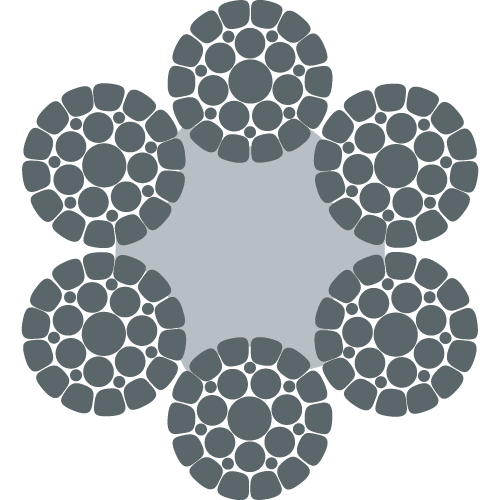
Multi-layer roration-resistant steel wire ropes are critical load-bearing components for lifting equipment. Their core design objective is to prevent suspended loads from rotating in mid-air, thereby ensuring operational safety and precision.
The non-rotating capability of these ropes does not stem from the material itself but rather from their structural design and stranding process: the inner and outer strands are laid in opposite directions (e.g., right-hand lay for the inner layer and left-hand lay for the outer layer). When the rope is under load, the inner and outer layers generate opposing rotational torques. Through precise calculation and design, these torques are made to cancel each other out, thereby significantly reducing or even eliminating—the rope's tendency to rotate.
Due to their exceptional stability and safety, multi-layer non-rotating wire ropes are widely used in a variety of applications, including tower cranes, construction hoists, truck cranes, crawler cranes, truck-mounted cranes, various dockside cranes, portal cranes, container cranes, mining winches, vertical shaft hoisting systems, heavy-lift vessels, and wind turbine installation vessels.

core: steel
strand: 1×7
standard: ISO 2408, EN 12385-4, GB/T 20118
view specifications

core: steel
strand: 1×7
standard: ISO 2408, EN 12385-4, GB/T 20118
view specifications
6-strand round strand hoisting wire rope is the most fundamental and widely used flexible load-bearing component in hoisting machinery. Its structure is relatively simple, typically consisting of six strands laid around a central core (such as the common 6×19S or 6×36WS configurations). The core comes in two types: fiber core (FC, providing elasticity and lubrication) and steel core (IWRC, offering high strength and crush resistance). The manufacturing process for six-strand hoisting wire rope is highly mature, production volume is high, and the cost is significantly lower than that of multi-strand rotation-resistant ropes.

core: steel
strand: Warrington-Seale
standard: ISO 2408, EN 12385-4, GB/T 20118
view specifications

core: fiber
strand: Warrington-Seale
standard: ISO 2408, EN 12385-4, GB/T 20118
view specifications

core: steel
strand: Warrington-Seale
standard: ISO 2408, EN 12385-4, GB/T 20118
view specifications

core: fiber
strand: Warrington-Seale
standard: ISO 2408, EN 12385-4, GB/T 20118
view specifications

core: steel
strand: filler
standard: ISO 2408, EN 12385-4, GB/T 20118
view specifications
Compacted strand wire rope is a type of wire rope produced through a specialized process in which the strands undergo compaction—such as die-drawing, rolling, or forging—either before or after being laid into the rope. This process transforms the contact between the individual wires within the strands from traditional point or line contact into surface contact. Such a structure significantly enhances the rope's fill factor, wear resistance, crush resistance, and breaking strength.
.png)
core: steel
compacted strand: Warrington-Seale
standard: ISO 2408, YB/T 5359
view specifications
.png)
core: steel
compacted strand: Warrington-Seale
standard: ISO 2408, YB/T 5359
view specifications

core: steel
compacted strand: Warrington-Seale
standard: ISO 2408, YB/T 5359
view specifications
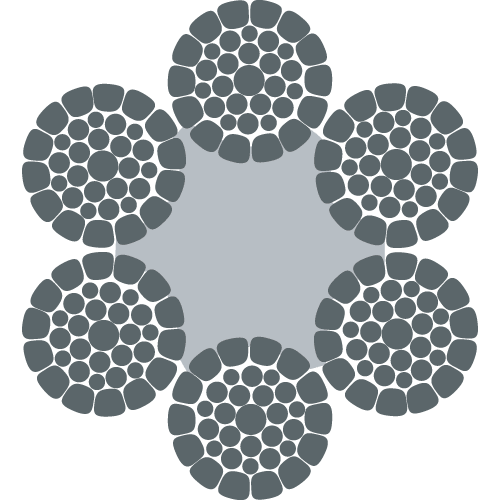
core: fiber
compacted strand: Warrington-Seale
standard: ISO 2408, YB/T 5359
view specifications

core: steel
compacted strand: Warrington-Seale
standard: ISO 2408, YB/T 5359
view specifications
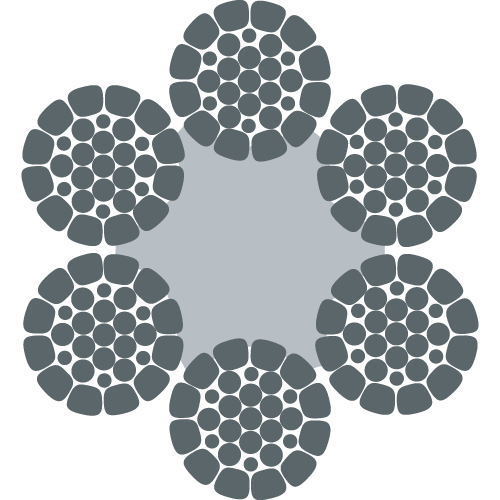
core: fiber
compacted strand: Warrington-Seale
standard: ISO 2408, YB/T 5359
view specifications







.png)